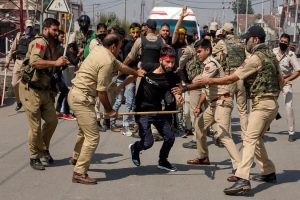



The Indian government has described the socio-political transformation of Jammu and Kashmir since 2019 as a step toward national integration, development, and equal rights. However, the sequence of constitutional and legislative changes introduced after the revocation of Articles 370 and 35A has fundamentally altered the region’s demographic, socio-political, and religious balance. These measures, taken together, are increasingly seen as contributing to the structural marginalization of Kashmiri Muslims, particularly in the Kashmir Valley.
The abrogation of Article 370 removed the constitutional safeguards that once protected permanent residency laws in Indian Occupied Jammu and Kashmir (IOJK). With new domicile rules introduced, thousands of individuals previously categorized as non-permanent residents, including Gorkhas and members of the Valmiki community, became eligible for residency certificates, government jobs, and educational quotas. While framed as inclusive reform, this shift expanded the pool of beneficiaries competing for limited public sector employment, university seats, and admissions into medical colleges.
These measures are portrayed as steps toward normalcy and development, but in reality, they are depriving Kashmiri Muslims of their land, resources, political power, and other rights. These steps were taken after 2019, when the special status of the region was revoked, and in 2020, a new domicile law was introduced, declaring non-native communities of the state as native. This strategy, driven by the Bharatiya Janata Party (BJP)’s Hindutva-led ideology, aims to marginalize this Muslim-majority region and gain voter support by declaring non-native communities as native because they are Hindu.
Subsequent legislative amendments in 2023 extended this transformation. The extension of Scheduled Caste status to the Valmiki community and the reclassification of various groups as Other Backward Classes (OBCs) significantly broadened reservation entitlements.
The inclusion of the Pahari community in the Scheduled Tribes has two aims: to create conflict between the Muslim and Gujjar communities, and to further recalibrate access to reserved seats in education, employment, and the legislative assembly, as Pahari is only a language group.
All these measures are being implemented in a region where the majority population already has limited control over their own resources and faces high unemployment. These expansions intensify conflict and reshape the distribution of opportunities, further marginalizing Muslims.
Another step was taken through changes in the Jammu and Kashmir Reorganisation (Amendment) Act, 2023, which increased the number of legislative assembly seats and introduced new reserved constituencies, including seats for Scheduled Tribes and displaced persons. In this process, more seats were allocated to Jammu, a Hindu-majority region and a traditional stronghold of the BJP, giving it greater relative representation compared to the Muslim-majority Kashmir Valley. This also helped create a favorable image among other communities by granting them the status of state natives and additional socio-political representation. This redistribution alters electoral arithmetic and dilutes the Valley’s political weight within the assembly framework. In a conflict zone, these measures constitute serious violations because they are illegal and implemented without the consent of the permanent residents of the region, which remains an internationally recognized disputed territory.
These combined measures, including domicile rights, restructured reservations, and constituency reconfiguration, demonstrate that the political influence and power of Muslims in Kashmir are being systematically reduced, as all Indian laws are now directly applied to and imposed on the region. Government jobs, which are already scarce, now operate under broader eligibility criteria. Educational quotas have been redistributed across new categories. Legislative influence has been recalibrated in ways that shift power toward Jammu. The result is not a sudden displacement, but a gradual structural transformation that changes who holds influence, who accesses opportunities, and who shapes policy outcomes. Through these legislative measures, Muslims in Kashmir are being deprived of their political and socio-economic rights. This is how the colonial mindset works.
In conflict-affected regions, policy decisions carry symbolic as well as material consequences. For Kashmiris, the post-2019 reforms represent more than administrative change; they signal a redefinition of belonging and power. For the BJP, these policies promote equality and integration. However, for many Kashmiris, they represent an ideological project aligned with Hindutva that seeks to consolidate political dominance by altering demographic and electoral equations.
What remains clear is that the social contract in IOJK has been rewritten. As legislative engineering reshapes representation and access to resources, concerns about marginalization among Muslims in the Valley continue. The long-term stability of the region will depend not only on integration policies but also on whether all communities feel equally protected, represented, and empowered within the new constitutional order.
The post-2019 restructuring and administrative tools used by the BJP in IOJK represent a fundamental reordering of power in a territory that remains internationally recognized as disputed. Through unilateral legal, political, and demographic interventions imposed without the consent of its permanent residents, the Indian government operates in a colonial manner, systematically reducing the socio-political and religious power and influence of Muslims in the region.