


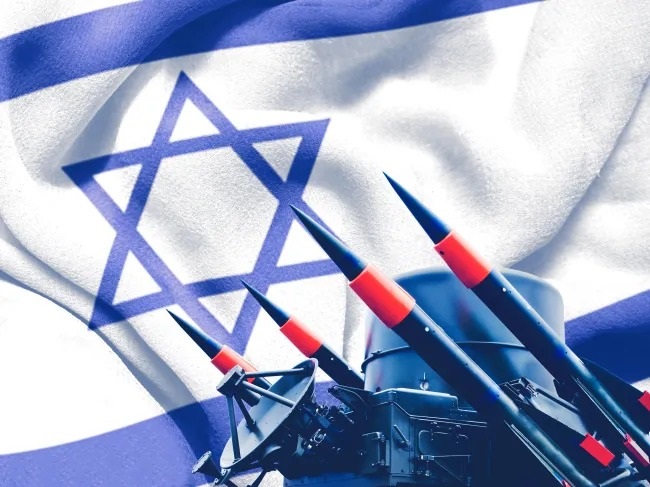
This article relates to the early years of rogue entity Israel getting its nuclear weapons programme started with the clandestine help of France and the United States (US), and with other European states joining in. In fact, Israel’s nuclear programme, which began in 1952 with the creation of the Israel Atomic Energy Commission, got off the ground because of the aid provided by France. To date no state, including Pakistan, has sought to insist Israel’s nuclear programme be brought within the framework of the International Atomic Energy Agency (IAEA).
Initially, in 1956, France agreed to provide Israel with an 18-megawatt nuclear reactor, but later made a more substantial commitment to support Israel’s nuclear ambitions in exchange for Israeli support in the 1956 Suez War. Following Israel’s invasion of Egypt, the reactor agreement was revised in October 1957 to provide a 24-megawatt reactor, while the cooling systems and waste facilities were designed to handle three times that capacity, without being subject to any IAEA safeguards. In addition, under protocols that were never formally documented, France agreed to supply a chemical reprocessing plant.
Prior to this Franco-Israeli agreement, no country had supplied such means for developing a nuclear capability to another state. As part of the arrangement, France procured heavy water from Norway for the Israeli reactor, thereby violating assurances given to the Norwegian government that the material would not be transferred to a third country. The French Air Force reportedly transported up to four tons of heavy water to Israel, while French authorities further maintained secrecy by instructing customs officials to describe major reactor components, such as the reactor vessel, as parts of a desalination plant destined for Latin America.
Even when France and Israel fell out over the project in 1960, the French agreed to finish shipping the reactor components and in 1964 the Dimona reactor became operational. The French also built the reprocessing complex here. Nor did the French feel they had done anything wrong in helping to lay the base for Israel’s nuclear weapons programme. Francis Perrin, former High Commissioner of the French Commissariat a L’Energie Atomique had declared that France did not violate any US agreements by aiding Israel’s nuclear programme in the 1950s because there was no agreement.
So by that logic, those states, and citizens of those states, that are not signatories of the Treaty on the Non-Proliferation of Nuclear Weapons (NPT), Missile Technology Control Regime (MTCR) and other such agreements, do nothing wrong if they provide missile and nuclear support for third countries. Or are different standards and logic in use for different states? And does the difference come down to religion? Interestingly enough, Perrin did admit that France might have broken a pact with Britain in that the French scientists who participated in the nuclear collaboration between the US, Canada and Britain were working as members of the Free French on behalf of the British government and had signed the British Official Secrets Act.
Nor was France alone in aiding and abetting the Israeli nuclear programme. The US, Israel’s main provider of military aid, was also aware of Israel’s nuclear project. According to Sir Timothy Garden, a fellow at Indiana University, Israel signed a nuclear cooperation agreement with the US in 1954. Between 1955 and 1966, more than 50 Israeli nuclear specialists completed a probationary period in the largest US scientific institutions. Israel received 6-10 kilograms of uranium a year starting in 1955. The total grew to 40 kilograms by 1966. The US provided Israel with a small nuclear reactor in 1955, which became operational in 1960. In 1958, US spy planes photographed the Dimona complex, but US Atomic Energy Commission’s (AEC) inspections of the Dimona facilities in the late sixties were hampered because of non-cooperation on the part of the Israeli government. In addition to controlling the extent of the inspections as well as the timing, according to analyst Rohan Pearce, Israel constructed false control panels and bricked up corridors to fool AEC teams. As Pearce puts it, ‘an October 1969 US government memo, reporting on discussions between State Department officials and a representative from the AEC, implied that the US government had no problem with Israel possessing the facilities for building nuclear weapons.’ The memo made it clear that the US was not prepared to support a real inspections effort.
With all this unsafeguarded nuclear assistance from France and the US, Dimona had already begun to produce approximately 8 kilograms of plutonium per year, enough for Israel to build one or two nuclear weapons once the material had been reprocessed.
From 1967 till the fall of the apartheid system in South Africa, Israel relied on the apartheid South African regime for the supply of approximately 550 tons of uranium for the Dimona complex. It is widely believed that the two states conducted a joint nuclear weapon test in the Indian Ocean in September 1979. According to reports in the Israel press in 1997, it is clear that the two states aided each other in building their nuclear capabilities. The first public confirmation of Israel’s possession of nuclear weapons came in 1986, when Mordechai Vanunu provided Britain’s Sunday Times with photographs of Israel’s nuclear facilities. Vanunu had been a technician at the Dimona Machon 2 facility between 1976-1985, after which he was fired for his left-wing, pro-Palestinian politics. Machon 2 is known to produce plutonium and components for nuclear bombs.
Despite all these public facts, the US has continued to aid and abet Israel’s nuclear and military capability. In October 1998, Israel and the US reached an agreement that committed the US to enhancing Israel’s ‘defensive and deterrent capabilities.’ An agreement reported in February 2000 between the two related to cooperation in nuclear and other energy technologies and this agreement allowed Israeli scientists to once again gain access to US nuclear technology. So it is hardly surprising to find that by October 2003, Israeli and US officials admitted that they had collaborated to deploy US-supplied Harpoon cruise missiles armed with nuclear warheads in Israel’s fleet of Dolphin-class submarines.
In addition to the proliferation undertaken by the US and France to aid Israel’s nuclear capability, India and Israel have also cooperated on the nuclear front and it is known that the second set of nuclear tests conducted by India in May 1998 were a joint Indo-Israeli venture. Of course, Indian nuclear scientists had been trying to link up with Israel in the field of nuclear technology since the eighties. As ex-Mossad agent, Ostrovsky, has described in his book, By Way of Deception, one of his assignments was to escort a group of Indian nuclear scientists in mid-July 1984, who had come ‘on a secret mission to Israel to meet with Israeli nuclear experts and exchange information.’
Of course, the efforts by these leading proliferating states were not confined to the official level only. There are documented thefts of material from US nuclear facilities being traced to Israel and there are cases of individuals in sensitive positions in the US working for Israel. The much publicised case of Jonathan Pollard is only one such instance (the Israelis conferred citizenship on him for his services while he was imprisoned by the US).
It is no wonder then that, today, estimates of Israel’s nuclear arsenal pinpoint to about 300 nuclear weapons. And, yet, within the international debate on Weapons of Mass Destruction in general and nuclear weapons in particular, the case of Israel is never raised.