


Yemen exercises vital control over the Bab-el-Mandeb, a key global trade and energy choke point. Maritime security of this point is paramount to Western economies and the global supply chain. The deepening rift between the Kingdom of Saudi Arabia (KSA) and the United Arab Emirates (UAE) in Yemen may further impede freedom of navigation for Western ships in the Red Sea. The crisis intensified when the UAE-backed Southern Transitional Council (STC) announced a two-year succession plan. Riyadh fears the absence of a clear, inclusive succession plan may create a power vacuum that could be exploited by the Houthis and other actors hostile to its national interests. In response, Riyadh-backed security forces led a counteroffensive, reclaiming some strategic ports and sites from STC. These clashes escalated when Saudi Arabia bombed a Yemini port, claiming it was being used to transfer arms, which ultimately prompted the UAE to call for the withdrawal of its forces. The rift between Saudi Arabia and the UAE signals a transition from a Houthi-centered war to a new internal struggle among former allies. Powers like the United States (US), China, Russia, and Iran will likely treat this crisis as a global theatre of competition to secure and expand their interests in Yemen.
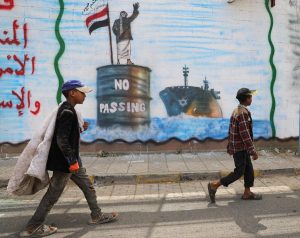
The Yemeni Armed Forces have warned that, unless Israel is pressured to halt its aggression and lift the blockade on the Gaza Strip, they will continue targeting Israeli and Western-linked vessels. This conditional posture has heightened risks to freedom of navigation for Western ships, while the apparent immunity enjoyed by Chinese and Russian vessels has produced a form of maritime apartheid in the Red Sea. Maritime apartheid is a term used to describe selective targeting of ships based on national alignment and corporate affiliation. Western states and their allies have centered their efforts on ensuring free and safe passage in the face of the Houthis’ repeated attacks in the Red Sea. Conversely, the Houthis and their allies claimed that their maritime campaign is a direct outcome of the genocidal campaign against Palestine. This growing internal conflict may create a vacuum for the Houthis and their allies to reinforce maritime apartheid in the Red Sea. With two US allies in conflict, the US alliance architecture can come under serious pressure. In parallel, the Houthis can complicate US efforts to ensure freedom of navigation and safe passage for US-aligned shipping in the Red Sea. Resultantly, other revisionist powers in the region, such as China, Iran, and Russia, can likely try to maneuver this situation to their advantage.
The political reality between KSA and the UAE is more nuanced with both states have evolved their strategies based on changing security, political and regional dynamics. They now seem to chase conflicting objectives on the grounds, where KSA wants a unified Yemen and the UAE supports separatism. Thus, members constituting the Gulf Cooperation Council (GCC), once a unified body that acted as a key partner of the US in the Middle East, now seem to follow diverging interests. Traditionally, the US-GCC unity considerably enhanced American political leverage in the region, but the latest conflict may challenge this established order. This conflict may force other GCC countries to choose sides or pursue independent interests. The conflict also challenges US aims to control Yemen through a unified alliance against the Houthis. The US may face profound alliance management strain in Yemen and the Red Sea. The crises in Yemen and the Red Sea underscore growing fragilities within US alliances. With the Houthis challenging Western commerce in the Red Sea, the growing rift between KSA and the UAE can portray American alliances as unreliable and internally divided, potentially emboldening other regional powers, such as China, Russia, and Iran.
China, a strategic competitor of the US, has been successfully able to cultivate good relationships with key players in the Middle East. China can be seen enjoying promising relationships with both KSA and the UAE, while simultaneously avoiding any conflict with the Houthis and Iran. This balanced approach has played a vital role in shielding Chinese maritime commerce, allowing it to pass safely through Bab-el-Mandeb Strait, unlike its Western counterparts. Moreover, investment in the form of the Belt and Road Initiative (BRI) has made China an important economic alternative for Middle Eastern countries. The active presence of the People’s Liberation Army (PLA) in ports in Sudan and Djibouti signals China’s increasing influence. A similar arrangement with Yemen could mark a milestone achieved to outcompeting other rivals in global trade. A PRC presence along Yemen’s coast can fundamentally challenge the Washington-dominated regional power balance.
This alliance management crisis in Yemen, if not handled with caution, can be a precise opportunity for other powers like China, Russia, and Iran to further challenge Western maritime security interests in the Red Sea. China pursues significant economic interests in the Middle East. Russia can leverage the current crisis to present itself as a flexible diplomatic and economic partner for Gulf states. To avoid a power rift, a complementary approach between China and Russia can produce a better outcome. Moscow can engage with Gulf partners in the military sector, while China, by means of its flagship BRI project, can pursue economic integration and infrastructural development in the Middle East. Together, a Sino-Russian cooperation plan can offer a comprehensive alternative to Gulf states, one that does not require choosing between them. But there are multiple structural and strategic obstacles that prevent the Gulf from fully abandoning its security partnership with Washington in favour of either China or Russia. The Middle East, however, can diversify its military partnerships with Russia, China, and the US, but completely sidelining Washington is neither realistic nor feasible for the Gulf.
The Red Sea, therefore, is becoming a critical arena for maritime security as the prolonged crisis in Yemen creates challenges for the US-led architecture based on post-Cold War freedom of navigation. By linking Red Sea selective blockade with the persistent denial of justice by rule base international order to Palestinians, Houthis are transforming red sea into geo-political space targeting commercial ships with political alignment. This selective application of international law in Palestine conflict spilled over into the selective disruption of maritime commerce in red sea undermines the freedom of navigation. The inability of major powers to address the challenges through legitimate channels can manifest itself in ways that affect global commerce and freedom of navigation for global commons.