

The beginning of 2026 made the underlying fluidity of international partnerships more pronounced. As the United States (US), under President Trump, pursued a more direct and transactional foreign policy, it dented American soft power. Meanwhile, China appeared to be expanding its global influence through different means, thereby enhancing soft power it had previously struggled to create.
The recent US actions have drawn international attention. On January 3, a jaw-dropping development left everyone around the world stunned as American military forces carried an operation justified by Washington as necessary for regional stability. The operation ended up with the capture of Venezuelan President Nicolás Maduro. Trump characterized this as part of a modernized “Monroe Doctrine” now termed as ‘Donroe Doctrine’ aimed at maintaining US influence in the Western Hemisphere. The operation brought chorus of condemnation from multiple Latin American governments and showcased US as abandoning multilateral norms and hampering a global harmony and stability.
Following these developments, at the World Economic Forum, Trump began to harp on about Greenland and directed a confrontational tone toward European leaders, which created concern among traditional European and the North Atlantic Treaty Organization (NATO) allies. European officials expressed discomfort with what they viewed as territorial coercion and diplomatic pressure. This sent a signal to countries around the world that the US would not even spare its own ironclad allies from such tactics. If this were the case, how could they trust the US to be the guiding spirit of the international order, or expect to be treated fairly when personal agendas so conspicuously overrode equitable relations?
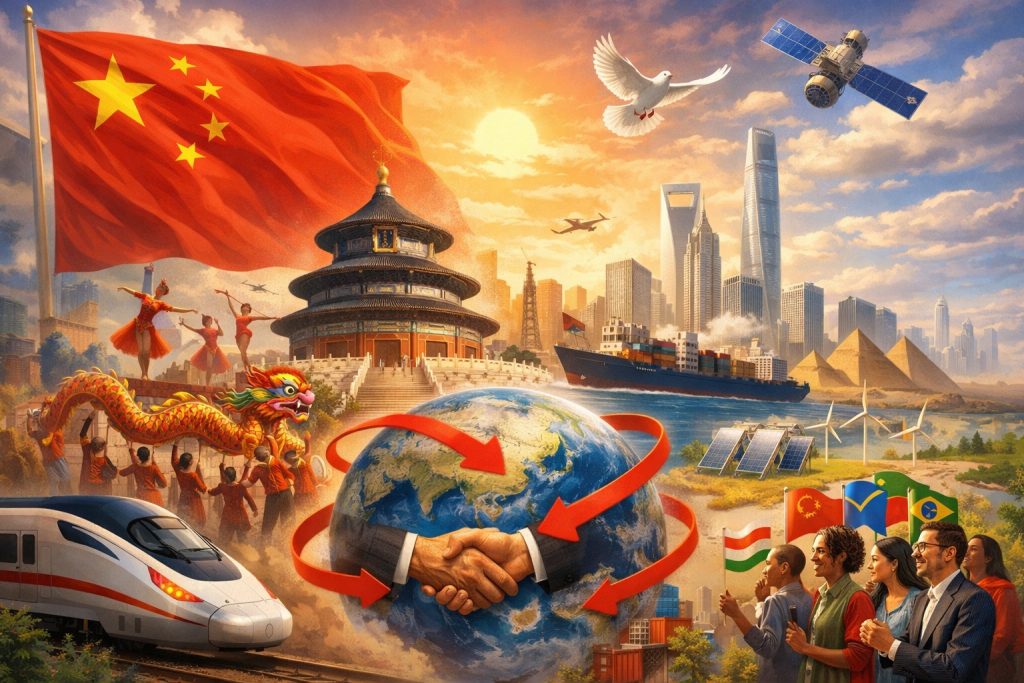
On the other hand, China seems to have long taken a principally different approach, which is slowly congealing its soft power across the world. Its foreign policy emphasizes non-interference in other countries’ internal affairs and focuses on economic development partnerships. This stance has resonated with nations looking for alternatives to conditional aid packages or political pressure from major powers.
The 2025 Global Soft Power Index shows China climbing to second place globally, closing the gap with the US across cultural, economic, and communication metrics. Chinese technology, brands, and media have become increasingly present in daily life across multiple continents, while its investment in innovation and Research & Development is way ahead of the US. As the Chief Executive Officer (CEO) of the world’s top chip manufacturing company, NIVIDEA, Jensen Huang, has recently stated that China would win the Artificial Intelligence (AI) race.
China’s Belt and Road Initiative and Global Development Initiative continue expanding infrastructure projects throughout the Global South. These programs appeal to countries in Africa, Southeast Asia, and Latin America that prioritize tangible development outcomes over ideological alignment.
The concept of soft power, developed by scholar Joseph Nye, describes the ability to influence others through attraction rather than coercion. Countries build soft power through legitimacy and shared values rather than purchasing it outright because soft power cannot be purchased off the shelf.
The current situation reflects what some analysts see as a transition toward a more multipolar world. At Davos, even close US allies voiced reservations about Washington’s approach. Trump’s announcement of a ‘Board of Peace’ intended to rival the United Nations received limited support, with many traditional partners declining participation. The Board of Peace, which has a plan for a ‘New Gaza’, has excluded Palestinian major stakeholders from its formation especially representatives of Palestinian public. There is no Palestinian member in its executive board that is supposed to oversee the implementation of its proposed plan for Gaza through a ‘technocratic Palestinian government’. This increasingly makes the plan an ‘imposed’ impractical attempt to complicate the Palestinian issue thereby triggering wider instability in the region.
While talking about global landscape at Davos, the Canadian Prime Minister, Mark Carney, described the current period as “a rupture not a transition”, suggesting the global changes underway represent more than temporary adjustments. In the aftermath of such a statement made by the Canadian PM, in January 2026, both China and Canada unveiled a roadmap that slashed tariffs on Chinese electrical vehicles (EVs) from 100% to 6.1%, while China dropped barriers on $7 billion of Canadian canola and lobster exports. This seemed to have drawn the ire of Trump. He threatened a 100% tariff on Canadian goods while he has repeatedly said he wants Canada to become the US’s “51st state.”
At the same time, there is a lingering possibility of Canada’s withdrawal from the F-35 deal with the US. The US has warned it could alter its decades-old North American Aerospace Defense Command deal with Canada should its government backtrack on the purchase of 88 Lockheed Martin F-35 fighter jets. Similarly, Ottawa’s refusal to certify an American jet making company has been met with threats with from the US president. Trump posted on Truth Social “…we are hereby decertifying their Bombardier Global Expresses, and all Aircraft made in Canada, until such time as Gulfstream, a Great American Company, is fully certified…”. Even though Canada has been making 75% of its defense purchases from the US but its leaders have indicated a possible diversification. This has raised fears in Washington that Canada’s preliminary Canada-China trade agreement signed in January 2026 could slowly morph into a strategic alignment with China. There are also emerging reports that the US officials met with Alberta separatists which prompted warning from the Canadian prime minister to respect Canada’s sovereignty.
Amid such a milieu, British Prime Minister Keir Starmer made a major visit to Beijing and Shanghai in late January 2026, the first by a United Kingdom (UK) leader in eight years. He and President Xi struck a deal centered on economics over politics, netting £2.2 billion in export opportunities and lower tariffs on items such as whisky. China also offered visa-free travel for British citizens, a clear sign it wants closer UK ties just as transatlantic relations fray. This development also irked Trump, who said that doing business with China is ‘very dangerous’ for the UK.
On February 5th, the New START Treaty, the last pact limiting US and Russian nuclear arsenals, expired. For the first time in over half a century, there is no legal constraints on the world’s two largest nuclear arsenals. This creates a perilous vacuum, with intelligence agencies warning of a dangerous new “launch-on-warning” era.
Simultaneously, the Middle East nears a boiling point. US and Iranian officials are holding high-stakes talks in Geneva, in a desperate attempt to de-escalate tensions. President Trump’s demand for “zero enrichment” faces firm Iranian defiance, seen as both a violation of the Treaty on the Non-Proliferation of Nuclear Weapons (NPT) rules and an attack on national sovereignty.
These parallel crises with Russia and Iran will further put American diplomacy to the test. The US may still have substantial military, technological, and economic capabilities. However, the effectiveness of these tools depends greatly on how other countries perceive the US and its role in the international relations, and whether they see the US as a reliable partner committed to shared principles.
China, on the other hand, may face its own challenges, however, many countries find China’s development-focused approach appealing compared to what they see as unpredictable US foreign policy.
The situation in 2026 shows how quickly international relationships can evolve. Countries increasingly make decisions based on practical considerations about economic development and strategic stability rather than traditional alliance structures. Soft power develops over time through consistent actions and perceived legitimacy, as aforementioned, it cannot be manufactured quickly or bought directly. For China, this moment may represent the culmination of years of relationship-building and infrastructure investment across developing regions.
The global system is adjusting to accommodate multiple centers of influence rather than a single dominant power. How this plays out will depend on the choices major powers make regarding engagement, cooperation, and respect for international norms that countries around the world value.