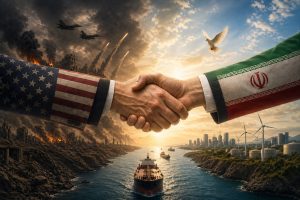



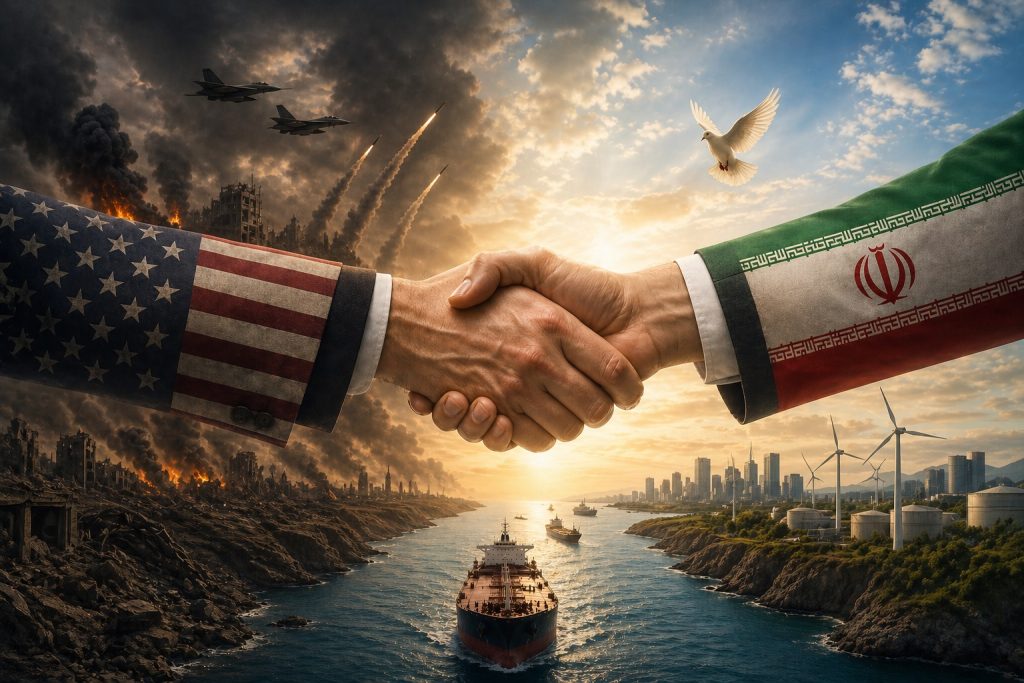
Despite speculations, it is not yet known when Iran and the United States (US) may resume negotiations, as both countries have hit a stalemate following the so-called first round in Islamabad. There were fears of war resuming between the US, Israel, and Iran; however, on Tuesday, US President Donald Trump posted about extending a ceasefire arrangement with Iran without giving any specific time frame, and reactions split in the familiar way. Some saw it as a routine political statement that could be used as a ruse to launch a surprise attack on Iran, while others read it as an admission that the current course with Iran is running out of road. However, whatever the intent, Trump’s post raises a question worth considering: what exactly will be gained from continued escalation, and at what cost?
It may be a hard pill to swallow for the US that it has to sit with the same country at the negotiating table for an off-ramp after it demanded ‘unconditional surrender’ just a few weeks back. American professors like John Mearsheimer are calling for Iran to be in the driver’s seat in this conflict and think that it would be to Iran’s advantage if the escalation ladder goes up, because this would lead to a complete shutdown of the Strait of Hormuz and Bab-al-Mandeb, thereby dashing the global economy by stymieing global oil trade.
The confrontation has been framed for weeks around resolve and deterrence. The working assumption has been that sustained pressure and attacks on Iran will eventually force a strategic rethink in Tehran that would allow the US, Israel, and their regional Gulf allies to extract some serious, specific concessions with regard to their regional interests. However, the results so far tell a more complicated story. Intensifying military and economic pressure on Iran has not produced decisive outcomes, and in a region where geography and global trade linkages impose their own hard limits, the room for further escalation is narrower than it appears.
Nothing exhibits this more plainly than the Strait of Hormuz. That narrow stretch of water carries a significant share of the world’s energy supply. A further warlike disruption there would not stay in the conflict zone. It would move to the Bab-el-Mandeb, another strait in the Red Sea, then to international markets almost immediately, affecting fuel prices, industrial output, supply chains (already under pressure before any of this began), and skyrocketing inflation.
It needs to be realized that current Iranian oil shipments and Saudi oil flow through the pipeline from Bab-el-Mandeb still provide 10% of the world’s supply, which would seriously vanish from the global supply chain in the event of an escalation, as the global oil strategic reserves are fast depleting. This would be tantamount to a disaster-like situation. Iran’s ability to influence these passages is not a theoretical risk. It is a live one, and conventional maritime operations do not neutralize it, as has been witnessed by the reluctance of US and its North Atlantic Treaty Organization (NATO) allies to actively take part in opening the strait of Hormuz.
This is where the economic dimension stops being background noise and becomes the central issue. The global economy is already absorbing supply chain pressures and uneven recoveries. A shock tied to energy flows would land first on Asia’s more fuel-dependent economies, but it would not stop there. Europe would face renewed vulnerabilities. The United States would encounter rising costs and inflationary pressures that no administration would find easy to explain away. At that point, escalation is no longer a tool; it is a liability.
As aforementioned, the original objectives remain largely unmet. Efforts to constrain Iran’s nuclear enrichment to zero , weaken its regional position, or trigger broader political change have not broken through. Iran has adapted, strengthened its deterrent, and absorbed external pressure in ways that make further escalation harder to calibrate. This is not a verdict of success or failure. It is an observation about the widening gap between what was expected, what has been achieved, and what could be achieved with further escalation.
Continuing down this path deepens that gap. It commits resources without clear evidence that more pressure will accomplish what previous rounds have not. More importantly, it raises the probability that costs will spill out of the strategic arena and into the daily lives of ordinary people; higher energy bills, more expensive food, and greater uncertainty about what comes next.
Against this backdrop, the idea of extending a ceasefire carries more weight than it might seem at first. It gives space to diplomacy rather than to coercion, which has caused instability. It reflects a recognition that escalation has limits, that a pause creates breathing room, and that policymakers can use that space to evaluate whether the current approach is still pointing toward long-lasting peace in the Middle East, something that President Trump aspires to have.
A more measured posture must be the way forward for the US, and it must consider ending the blockade, which remains one of Iran’s prerequisites for negotiations in Islamabad, by paving the way for diplomacy with Iran. At the same time, the entrenched distrust following Iran being attacked in the midst of negotiations and the US’s unilateral withdrawal from the Joint Comprehensive Plan of Action (JCPOA) in 2018 indicates that even diplomacy between the two remains truncated. However, the idea that the conflict brings home is that the approach of coercion will lead to a dead end by creating more instability, while suggesting it will not be of any help in the future. This is an acknowledgment that complex conflicts rarely bend to straight-line strategies. In this case, the interaction between military dynamics and economic realities suggests that further escalation may produce less and cost more with each passing round.
The moment calls for a cautious approach and avoiding actions that could set off broader instability. The signal embedded in Trump’s ceasefire announcement, whether intentional or not, suggests there is still time to adjust course. Whether that time is used wisely will shape not only how this conflict ends, but how much of the burden falls on people who never had a say in how it began.