



The ongoing release of the redacted Epstein files is setting off a political inferno worldwide by featuring the names of state officials, diplomats, and celebrities. Other than the United States (US), there are several mentions of other states, including Israel and India. The emails show a deep link between the Indian Bharatiya Janata Party (BJP), the Indian elite and Jeffrey Epstein. For example, in one email, the ex-Harvard President Larry Summers asked Epstein a question about whether Trump is a better choice as president or not. Jeffrey responded, “Yes, definitely India-Israel, for example, great and all his doing.” The evidence showcasing how malleable the Indian BJP has been to manipulation by sex offenders like Jeffrey Epstein. In this context, Indian decision-making and governance are being questioned by the Indian public as well as the Indian Congress Party. It is not just an issue of domestic governance but also a question of who is responsible for decision-making in India and how far this influence goes.
In international relations terms, to be a responsible nuclear state, the decision-making should be credible and independent of any foreign influence. If Indian leadership is so deeply influenced and run by global elites and even criminal networks like Epstein, then responsible conduct in the nuclear dynamic becomes questionable.
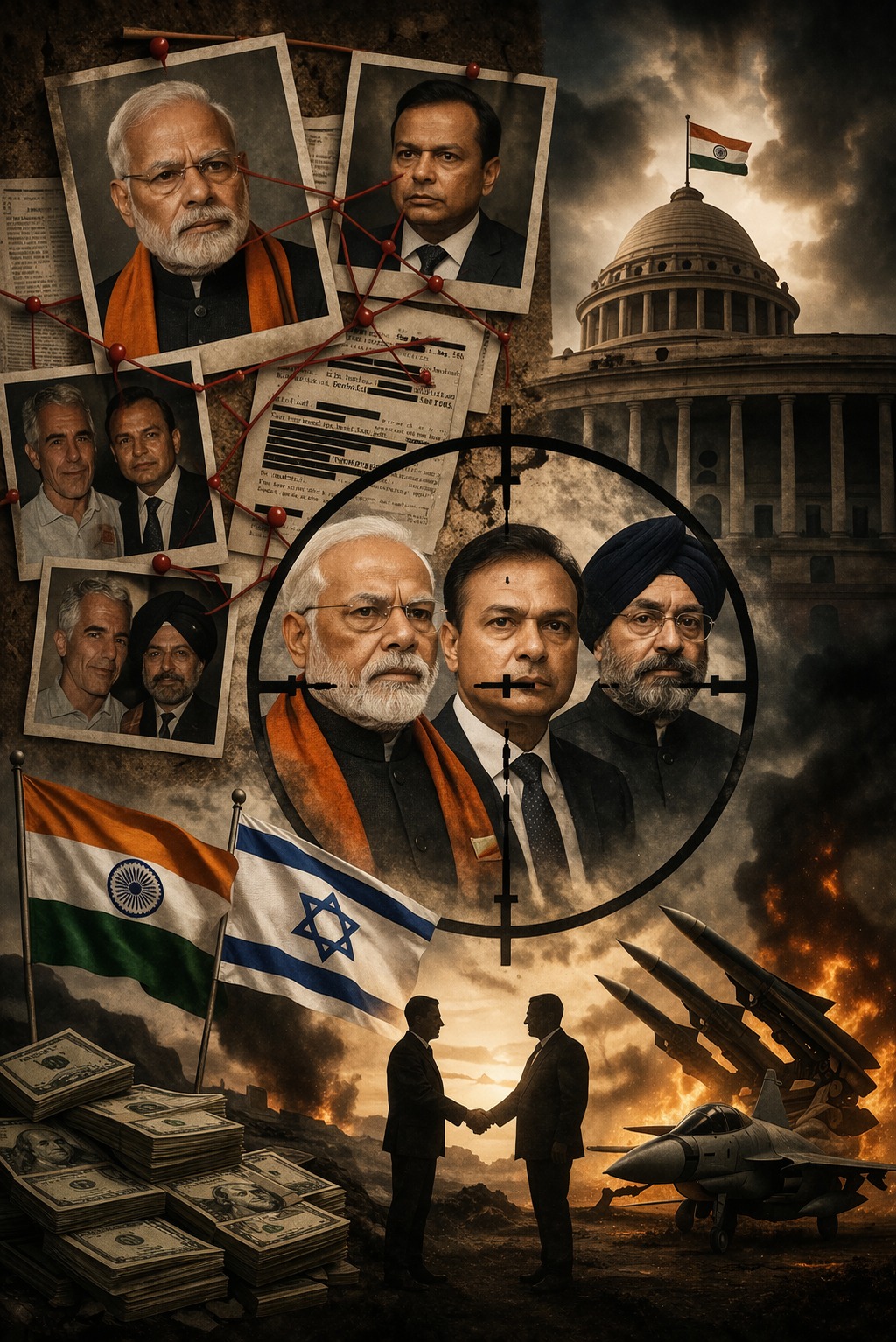
The most popular names from India in the Epstein files include the Prime Minister Narendra Modi; former diplomat and now a BJP member, Hardeep Singh Puri, and business tycoon Anil Ambani. There were several email exchanges between Ambani and Epstein on topics like sizing up incoming US ambassadors to India and setting up meetings between Modi and US state officials. Moreover, there were also discussions regarding arms trade deals. The emails show how Ambani and Epstein set up a meeting between Prime Minister Modi and President Trump, after which Modi visited Israel in 2017. This visit was the first ever by an Indian prime minister to Israel, marking a shift in New Delhi’s stance on the Palestine conflict. During the visit, both states signed a defence partnership under which India became the largest buyer of Israeli weapons, making up to $715m. After this, Epstein emailed an unknown person, Jabor Y, “Modi danced and sang in Israel for the benefit of the US president.” He also stated in the same email that “they had met a few weeks ago. It worked!” This shows how Epstein, along with Indian businessmen like Ambani, orchestrated strategic and political decisions of India while Modi only played his part.
The link goes deep, as in 2016, around the same time, Ambani’s Reliance Defence Ltd made a joint venture with an Israeli state defence group in a deal valued at $10bn. This looks more like a personal trade between Ambani and Israel at the cost of Indian strategic and geopolitical decisions. Ambani signed his company’s deal with Israel, after which he, along with Epstein, brokered a meeting between Modi and Trump to make Modi agree on visiting Israel and becoming the biggest buyer of Israel’s strategic assets. It might be a good decision for India, but it shows how heavily manipulated decisions are being taken by the decision-making bodies, not just affecting the political dynamics but also strategic decisions, with geopolitical implications at a broader level.
Another email exchange between Epstein and Ambani shows that just before the 2019 national elections, Epstein offered to arrange a meeting between Modi and former White House Chief Strategist Steve Bannon. The details of this meeting are still unknown. Later, Ambani met Epstein on the day the results were announced. Ambani doesn’t hold any position to approve domestic, political and strategic decisions on behalf of the Indian government, but somehow, he was doing all this, and Modi was on board. However, the Congress Party doesn’t agree with the narrative of this being normal, supported by the BJP’s reluctance to talk about the released files, which show that the government, as one body, was not on board with this type of decision-making process.
Another name that was featured in the Epstein files is Hardeep Singh Puri, who retired from the Indian Foreign Service to join the BJP in 2014. Puri wanted to meet LinkedIn owner Hoffman for investment opportunities in India. In one of his emails to Jeffery, he said, “Please let me know when you are back from your exotic island,” also mentioning gifting him some “Indian books to excite an interest in India”. This shows that Puri knew about the island and also called it “exotic,” pointing to his knowledge about the island wasn’t just about its existence. Despite that, he maintained strong relations with Epstein, as disclosed by other emails between the two.
On the other hand, this shows a huge lapse in the decision-making body of India. The recently released Epstein files have already spurred anxiety in the Indian government as well as the public. The manipulated strategic deal agreements, like the one with Israel, might also weaken the confidence of other states, including Pakistan, in any strategic decision, whether Indian decision-making bodies will be making the choice in a crisis situation or will it be someone else driven by personal motives and influenced by global elites. This reduces the probability of accurately calculating the rationality of a state’s actions, particularly given that India is a major nuclear power. This situation not only threatens the region but also poses risks to the international community, especially in determining whether, during a crisis such as the recent May 2025 Pak–India crisis, decisions by India were made by its formal decision-making bodies or by individuals who do not have the best interests of the region in mind.
The scary thing is that instead of holding the involved personnel accountable for such lapses in important decision-making, the Indian BJP is denying any connection to Epstein and that his manipulations in state decisions, calling these emails totally rubbish, while the opposition party, Congress, does not agree with the narrative and is calling the released files an exposé on how the BJP is open to foreign manipulations.
Ambani and Epstein manipulated a deal out of the BJP government with Israel to buy the largest amount of weapons as if India was preparing for a war. Besides domestic chaos, increasing strategic and arms purchases can potentially fuel a conflict with neighbouring states. Making deals as a result of inducement and manipulation, and not through state institutions, is a risky and irresponsible move because a state institution is unlikely to take a move that can ignite unwanted conflict, more than a rich person who would not be impacted by a potential conflict triggered by a not-so-well-thought-out decision.
Although lobbying itself is not inherently unlawful, Jeffrey Epstein was a convicted sex offender at the time he exchanged emails, held meetings, and communicated with members of the Indian leadership. Anil Ambani reportedly also was offered a “tall Swedish Blonde” by Epstein in one of the emails, making Ambani one of the potential sex offenders who might have been directly involved in trafficking and assaulting women. Despite this status, the Indian government engaged him in Indian decision-making processes with the assistance of Ambani, who met, communicated, and took decisions with him on behalf of the Indian BJP.
Indian public and representatives of the Indian National Congress questioned the basis on which Ambani was considered fit to represent the Indian state, noting that he held no formal governmental designation. Observers from South Asia expressed similar concerns. They questioned why India, a major nuclear power, permitted individuals without official authority or constitutional mandate to participate in discussions and decisions ostensibly made on behalf of the government.
To restore the confidence of political parties, the Indian public, and the international community, it is essential for India to hold those involved accountable for manipulating domestic, political, and strategic decision-making. The US could also play a role by conducting an investigation into Epstein’s involvement in influencing Indian decision-making, given the potential impact it could have had on other states, and by holding those individuals involved, particularly if they are US citizens, responsible.