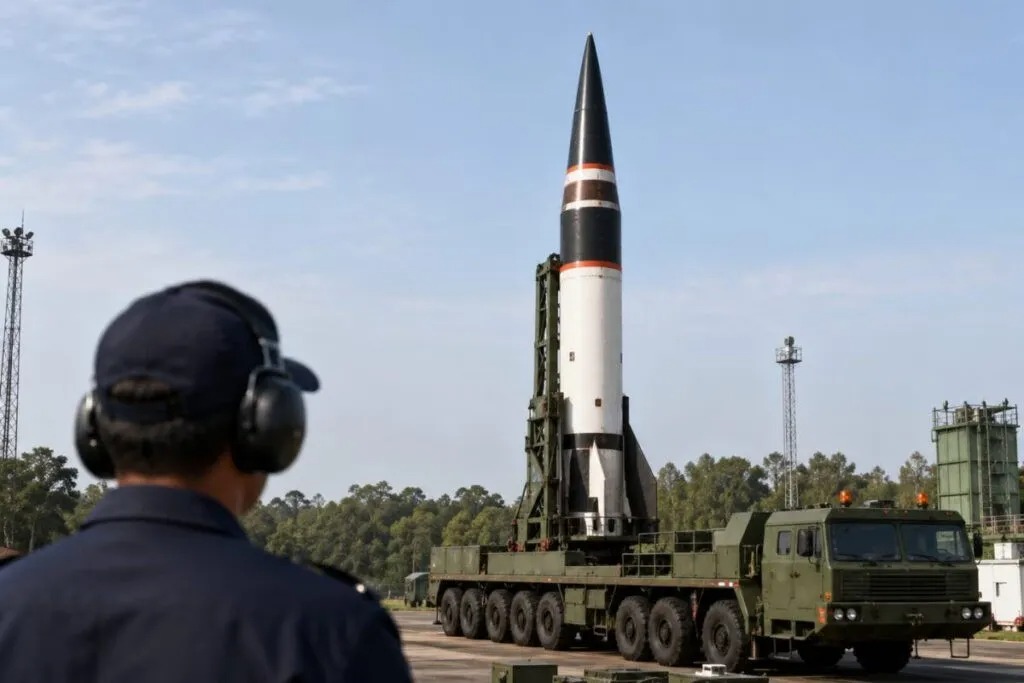



On April 30, 2026, India’s Defence Research and Development Organisation (DRDO) Chairman, Samir V. Kamat, made a public announcement that India is ready to develop the Agni-VI, a nuclear-capable intercontinental ballistic missile with a range estimated at 12,000 kilometers and equipped with multiple independently targetable warheads. At that range, the missile does not only cover China and Pakistan that are already well within the range of India’s existing arsenal, it reaches the Middle East, Europe, the United States and even Canada. India is, thus, without apology or adequate international scrutiny, ready to join the exclusive and deeply consequential category of states capable of delivering nuclear warheads to the Western hemisphere.
India’s nuclear doctrine has always been cast in the language of “credible minimum deterrence,” directed toward regional adversaries. Yet the possible development of Agni VI, an intercontinental ballistic missile (ICBM), challenges that framing. Agni-V, with a range of 5,000–8,000 km, already allows India to target the entirety of China, the Asia-Pacific, and beyond. The Agni-VI, reportedly increases to 10,000–12,000 km and is reported to carry Multiple Independently Targetable Reentry Vehicle (MIRV) warheads, each capable of striking separate targets. If New Delhi proceeds with such a missile, it would make major shift in South Asia’s nuclear dynamics amid India’s decisive pivot from deterring near neighbors to having global strike capability.
The development of Agni-VI’s extended range and MIRV capability also represents India’s attempt at parity with Beijing’s own intercontinental arsenal. This shows that this is less about necessity and more about prestige and India wants to be seen as belonging to the exclusive club of global nuclear powers. At home, the optics of an Intercontinental Ballistic Missile (ICBM) development will, no doubt, be celebrated. Since the Bharatiya Janata Party (BJP) came to power, there has been a marked emphasis on projecting military strength as a symbol of national pride. Missile tests are routinely broadcast as demonstration of India’s technological prowess and global standing. Moreover, the international community, particularly in the West, face a pure dilemma. On the one hand, India is often viewed as a strategic partner in balancing China’s rise. On the other, New Delhi’s pursuit of ICBMs contradicts the logic of defensive deterrence. It signals ambition untethered to regional security requirements. European states and the United States have little reason to welcome an India that can hold their cities at risk, especially when India’s stated adversaries lie well within the range of its existing arsenal. The Agni-VI would fit squarely within the narrative that India is asserting itself as a power capable of global reach. This development suggests an Indian aspiration not just to defend but to dominate and it has transformed India into a source of broader global nuclear insecurity.
This development should trigger broader debate on nuclear responsibility. India has long presented itself as a responsible nuclear state and, as a consequence, it has enjoyed special privileges, including access to civilian nuclear technology despite not being a signatory to the Nuclear Non-Proliferation Treaty (NPT). But an Indian ICBM with a range of 12,000 km, particularly one equipped with MIRVs, could erode this carefully cultivated image. Critics in Europe and North America should ask this question why a country with no extra-regional enemies requires a long-range missile and whether those privileges of civilian nuclear technology should now be reviewed, or conditioned on meaningful transparency commitments. The international community has so far lacked the political will to ask such significant questions.
In South Asia, the immediate impact of such a test would be to exacerbate insecurities. Pakistan, India’s nuclear-armed rival, has long viewed New Delhi’s missile buildup as a threat to the region’s fragile stability. Islamabad has responded in kind with its own developments, including short-range tactical nuclear weapons designed to offset India’s conventional superiority. The introduction of an Indian ICBM, however, would shift the game to a new level. However, Pakistan cannot and need not match this capability because it has no global ambitions. The danger here is not only strategic instability but also a gradual unraveling of norms. If India is permitted to expand its arsenal without pushback, others may feel emboldened to do the same. Already, the global arms control regime is fraying under the pressures of great power competition. Adding India’s ambitions to the mix only deepens the crisis.
Moreover, the Agni VI is not an isolated development. It stands at the top of a systematically expanded nuclear architecture that India has been developing for quite some time. On April 7, 2026, Indian government announced criticality of the Prototype Fast Breeder Reactor (PFBR) at Kalpakkam. These PFBRs are operating entirely outside the International Atomic Energy Agency (IAEA) safeguards and they are capable of providing the plutonium foundation for precisely the kind of MIRVed warhead multiplication that Agni-VI would require. Similarly, the canisterization of missiles and the test of rail-mobile Agni-Prime on 24 September, 2025, demonstrate a force structure clearly designed for second-strike survivability and preemptive first strike. If we look at all three developments: the unsafeguarded PFBRs the material, canisterization along with rail mobility provides survivability and Agni-VI provides the global reach. These developments tell a single story that India no longer adheres to the concept of recessed deterrence (where weapons are kept de-mated and away from operational deployment) and global norms.
The DRDO Chairman’s announcement is a strategic declaration that demands a reckoning in every country that has quietly extended India the privileges to access nuclear and missile technology without asking hard questions in return. India has now confirmed the development of a weapon for which no regional adversary provides a credible justification, a missile that covers territories its stated enemies do not occupy, with a warhead architecture designed to defeat the missile defense systems of powers it publically calls partners. The international community must decide whether it will engage with that reality or continue to look away in the name of strategic convenience. A successful test would not just mark a technical milestone for India rather; it would effectively mark a departure from restraint. For South Asia, it would inject new volatility into an already unstable neighborhood. For the world, it would be a reminder that nuclear ambitions, once unleashed, rarely remain confined to the stated purposes. The international community must not overlook this development. If India crosses this threshold, the global security landscape will tilt in ways that extend well beyond the Indian Ocean. The question is not whether India can build such missiles, it clearly can, but whether the world can afford the consequences if it does.