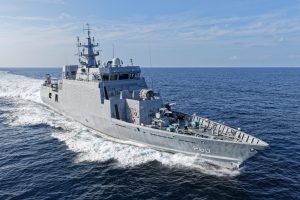
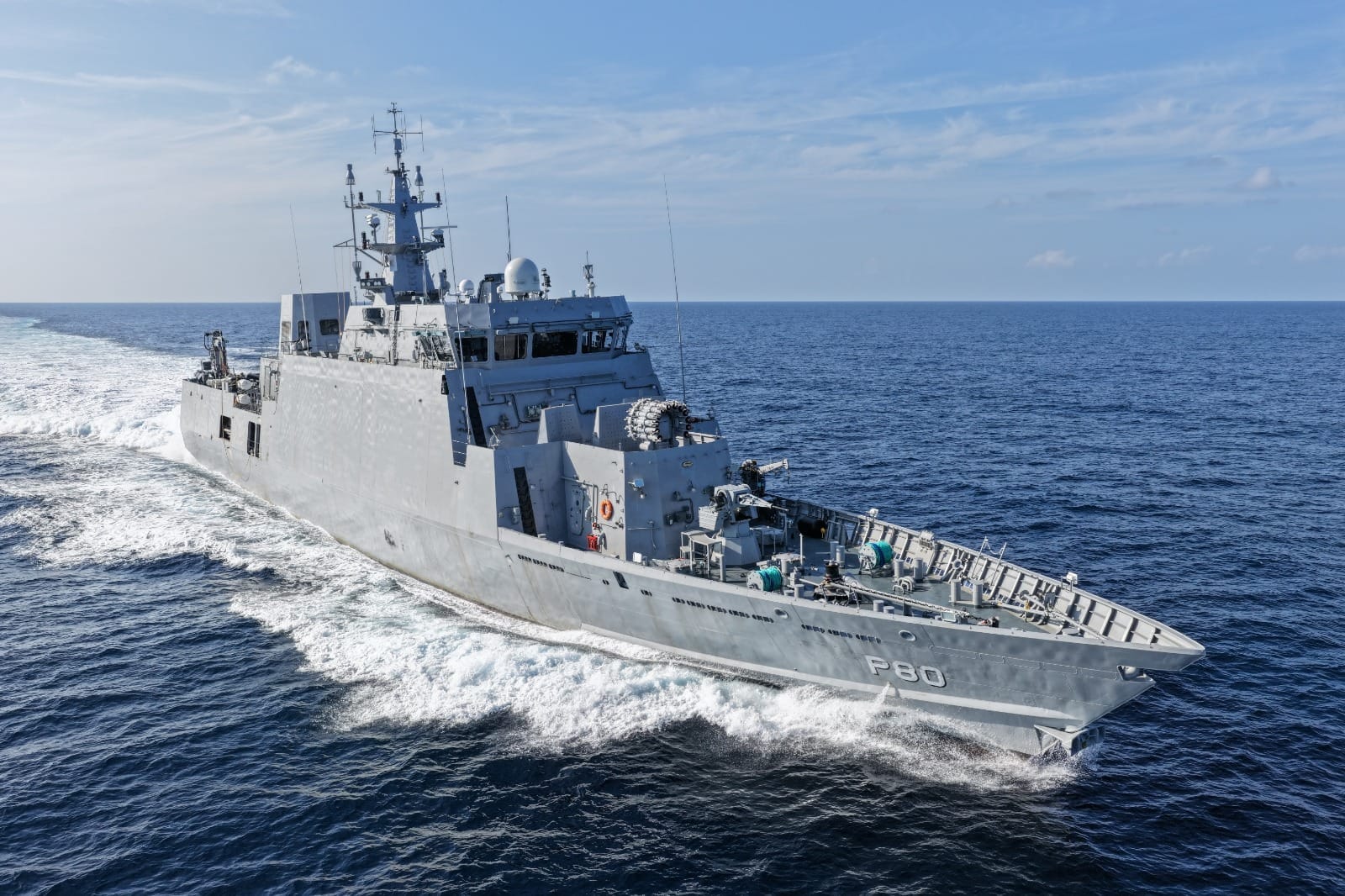



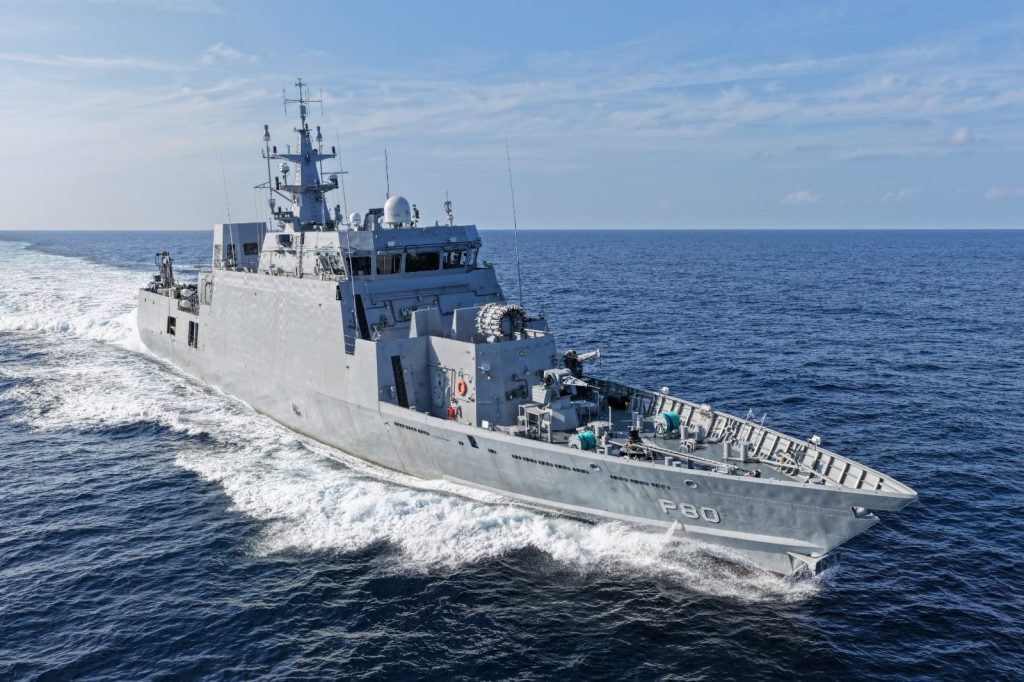
The Indian Navy commissioned INS Mahe, a new class of corvette designed for anti-submarine operations, a fewdays ago. The induction of INS Mahe is a significant development that deserves attention for three key reasons. Firstly, it is designed to operate in shallow waters, making it suitable for missions in the North Arabian Sea, which will pose an additional challenge to Pakistan’s submarine force. Secondly, it reflects India’s rapid growth in shipbuilding capabilities, as these sixteen vessels are being built at an unprecedented rate and will be further discussed in later sections. Lastly, and significantly, the article emphasizes that the induction of anti-submarine warfare (ASW) vessels with the ability to defend littorals demonstrates that the Indian Navy is now on the path to reinforcing its anti-access/area denial (A2/AD) capabilities while simultaneously pursuing blue-water ambitions.
INS Mahe is part of the Indian Navy’s Anti-Submarine Warfare Shallow Water Craft (ASW-SWC) program. Under this project, the Indian Navy has decided to induct 16 ASW Corvettes worth Rs 13,000 Crore. Eight of them are being built by Garden Reach Shipbuilders & Engineers (GRSE), while eight are being constructed simultaneously by Cochi Shipyard Limited (CSL). The weapons, propulsion, and electronics packages of both the Arnala- and Mahe-class corvettes are identical; however, notable design differences are evident in the placement of the 30 mm gun deck, ASW rocket launcher, and torpedo launcher, as well as in the stern design.
The Arnala-class corvette is 77 meters (m) long, has a displacement of 1490 tons, and can accommodate 57 personnel. Three diesel-electric engines power the platform. However, the Mahe-class is 78 m long, has an approximate displacement of 900 tons, and can reach a maximum speed of 25 knots (kt). The maximum operational range is set at 1800 nautical miles (nm) while travelling at a speed of around 14 kt.
The ASW corvetteis equipped with a variety of weapons, including light torpedoes, anti-submarine rockets, and mines. Their primary ASW armament consists of a forward-mounted 12-tube RBU-6000 rocket launcher, effective against close-range underwater threats. The RBU-6000 can reach up to 8,900 meters and neutralise targets at depths ranging from 10-500 m, with a 25kg high-explosive warhead. It also has two triple 324mm torpedo launchers that can fire the indigenously developed Advanced Lightweight Torpedo (ALWT), which can strike a submerged target at a depth of 650 m at a range of 20 km at a speed of 50 kt.
It also incorporates stealth technology to reduce its radar cross-section (RCS), along with a low acoustic and infrared (IR) signatures to protect the vessel from detection by the adversary’s submerged platforms. In addition, the corvette carries anti-torpedo decoys to divert the incoming torpedoesso they hit the decoys instead of the vessel.
These corvettes are designed mainly to detect, track, and engage submerged platforms, whether crewed or uncrewed, especially near coasts and in shallow waters. With advanced underwater sensors like the hull-mounted sonar Abhay, an acoustic communication system, and a low-frequency sonar, they can perform thorough underwater surveillance.
These corvettes will fill the gap, especially in shallow waters where large naval ships cannot operate with much freedom due to several constraints, primarily the seabed’s depth. These corvettes, with their low draught of only 2.7 m, allow them to operate safely in littoral and coastal waters, where deeper-draught ships (like frigates or destroyers) cannot safely go. This makes them a suitable platform for ASW operations.
The platform reflects the Indian Navy’s objective of transforming from a “Buyer’s Navy” to a “Builder’s Navy”. The Indian Navy is actively engaged in an ongoing, ambitious project. As part of this initiative, the Navy is building a new ship approximately every forty days. Moreover, the goal is to operationalize more than 200 surface and submerged platforms by 2035. The ASW platforms are part of this broader project, which currently includes 52 platforms under construction in domestic shipyards, including the ASW vessels.
Besides, these corvettes illustrate a new dimension of India’s maritime strategy; an enhanced focus on reinforcing A2/AD capabilities. Already, for static defence, the Indian Navy has a plan to operationalize long-range shore-launched anti-ship BrahMos coastal defence batteries and shore-launched anti-submarine torpedo with a 643 km range, known as the Supersonic Missile-Assisted Release of Torpedo (SMART) system by 2027.
The Arnala-class and Mahe-class corvettes are part of the mobile defense shield of the A2/AD shield that the Indian Navy is trying to build. These corvettes will not work alone but will also work in synergy with the Indian naval air fleet, such as the P-8 Poseidon, MH-60 Romeo, and MQ-9 Sea Guardian, which are being ordered from the United States, thus forming a formidable A2/AD shield.
The mission of these vessels will be to conduct operations on the “Western Sea board”, according to the Indian Navy, which affirms their Pakistan-centric role. To counter this emerging threat, the Pakistan Navy can respond by employing long-range air-launched C‑802AK and CM‑400AKG anti-ship missiles. The C‑802AK, with a 180 km range, is a potent sea-skimming missile designed to strike naval platforms with precision, while making its detection harder by the adversary’s air defense systems. On the other hand, the Pakistan Navy can also employ the 400 km-range CM‑400AKG to hit these moving corvettes from stand-off distances at almost hypersonic speeds.
The new shallow-water corvettes reflect the growing prominence of an A2/AD posture in India’s maritime strategy. This poses an additional challenge for the Pakistan Navy’s submarine fleet when conducting operations within the Indian exclusive economic zones. However, with synergy, these platforms (ASW Corvettes) can be effectively taken out of the equation when needed, as the Pakistan Navy has formidable firepower in its arsenal capable of conducting such missions.